No Accident: Poland and Wilson’s Fourteen Points
By Janek Wielgosz
Jan 8, 2026
Listen To This Article
On this day in 1918, Woodrow Wilson stood before the United States Senate and outlined a sweeping vision for a peaceful global order in the wake of the First World War. Among Wilson’s famous Fourteen Points was the aspiration that:
“An independent Polish State should be erected which should include the territories inhabited by indisputably Polish populations, which should be assured a free and secure access to the sea, and whose political and economic independence and territorial integrity should be guaranteed by international covenant.”
This extraordinary moment set in motion events that would soon lead to Poland’s return as a sovereign country after 123 years of partition. However, the inclusion of Poland in Wilson’s plan was no accident. It took the resolve, passion, and charisma of Polish leaders and sympathizers to bring this dream to fruition.
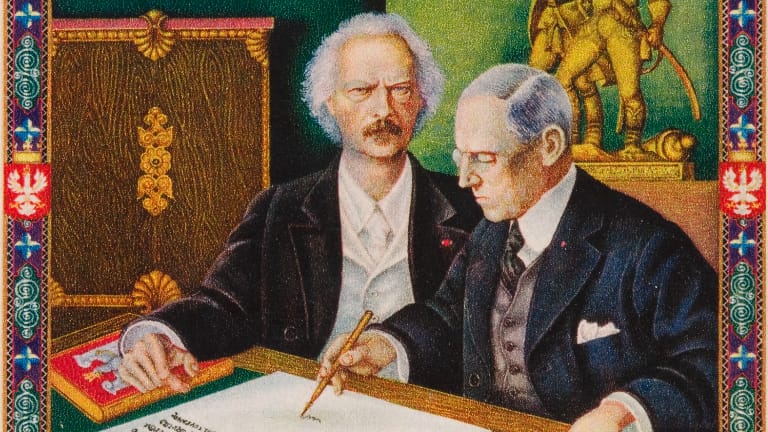
Chief among these figures was the statesman and renowned pianist Ignacy Paderewski, whose deep connections to the Wilson administration and diplomatic finesse helped secure American support for a nascent Polish state. As Paderewski wrote in a telegram to President Wilson in October 1917:
“You are the foster-father of a chiefless land. You are Poland’s inspired protector. For many a month the spelling of your name has been the only comfort and joy of a starving nation.”
The cause for a Polish state faced tremendous odds, both in Europe and within Wilson’s circle of advisors. Some suggested that Poland should be made a federal state within a fictitious “democratic, federalized” Russia, or absorbed into Austria. Others argued that Poland’s borders ought to be strictly defined by linguistic concentration, in Wilson’s words: “territories inhabited by indisputably Polish populations.” Still others nursed plainly anti-Polish sentiments, exemplified by the views of Columbia University professor Vladimir Simkhovitch:
“Anyone knows … perfectly well that [Poland] … has to be a part of one of the two great systems, either Russian or German. Even if Poland somehow became ‘truly independent,’ she would be a ‘backward, impoverished, reactionary, agricultural country.’”
Yet through the strategic diplomacy and alliance-building of giants like Ignacy Paderewski, the political drive of Polish National Committee president Roman Dmowski, and Commander-in-Chief Józef Piłsudski’s pragmatic statecraft and command leadership, Poland’s independence was won. The gyre that President Wilson set in motion on January 8 gained speed through 1918 until, on November 16, General Piłsudski issued his famous telegram to the nations of the world:
“As the commander-in-chief of the Polish Army, I hereby notify war-faring and neutral governments and nations of the existence of an Independent Polish State, encompassing all lands of united Poland. […] The Polish State arises from the will of the entire nation and shall be based on democratic principles.”
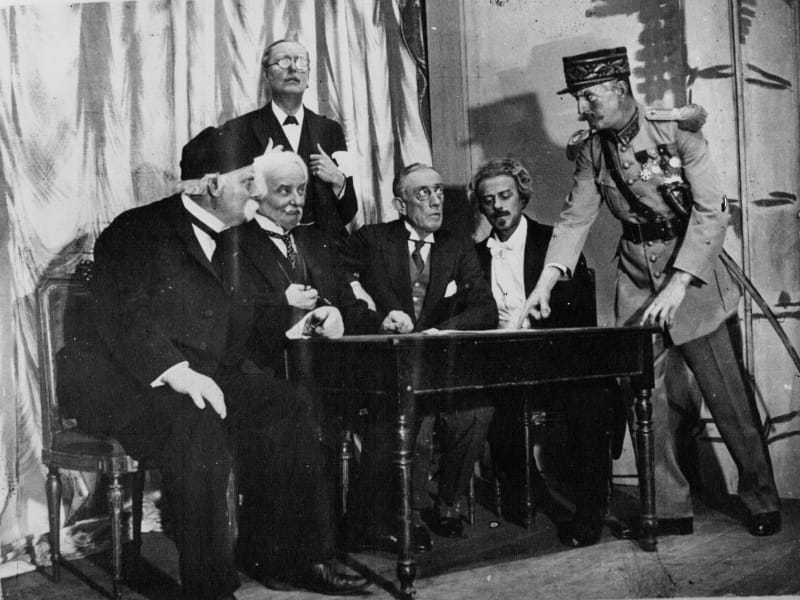
‘Les acteurs de Versailles’ – Clémenceau, Lord Balfour, Llyod George, Wilson, Paderewski, Foch
Sources:
https://www.theworldwar.org/learn/peace/fourteen-points
https://culture.pl/en/article/why-does-poland-celebrate-independence-day-on-11th-november
https://history.state.gov/historicaldocuments/frus1917Supp02v01/d701
Biskupski, M. B. “Re-Creating Central Europe: The United States ‘Inquiry’ into the Future of Poland in 1918.” The International History Review 12, no. 2 (May 1990): 249–279.